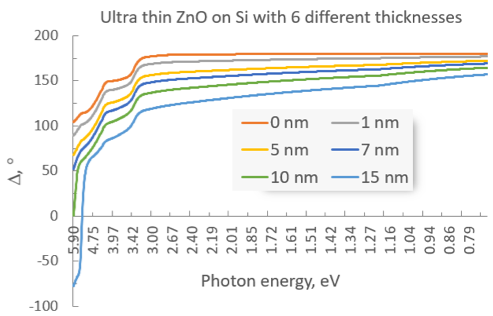
Wavelength range: 210 – 1690 nm.
Nr of wavelengths: 1065.
Incident angles: 45° – 90°.
Measure complete spectrum in 1/3 of a second.
Spot size: 120 μm.
Sample scan: up to 200 mm (8 inch).
Obtainable Data
- Film thickness
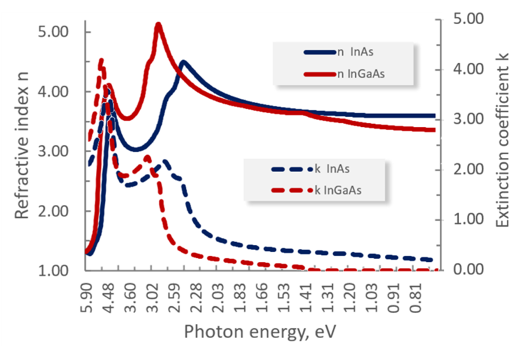
- Dispersion of complex optical constants:
- Refractive index n
- Extinction coefficient k
- Band gap
- Surface roughness
- Interfacial mixing
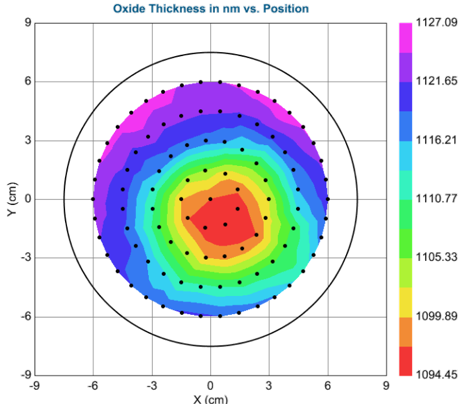
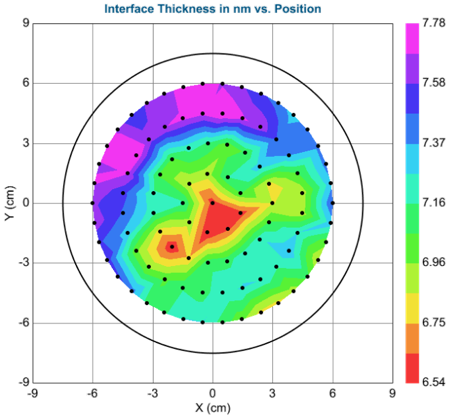
- Uniformity
- Anisotropy
- Composition
- Crystallinity
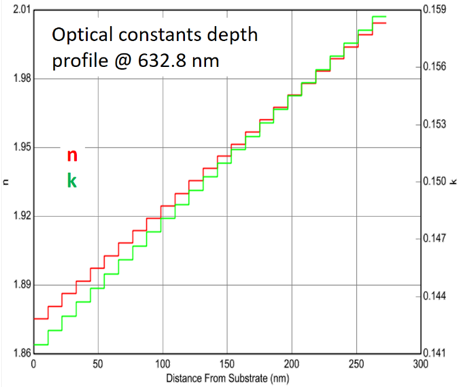
- Graded film
- Porous films
Materials
- Thin films starting from ~1 nm
- Thick films up to ~ 10 mm
- Multilayers and bulks
- Any materials (metals, semiconductors, dielectrics), which reflects light in the given wavelength range
- Liquid samples
Application
- Low bandgap semiconductors
- Conductive organics
- Metals, alloys
- Dielectrics
- Mapping: map thin film uniformity (e.g., of wafers or glass panels)
- Anisotropic applications
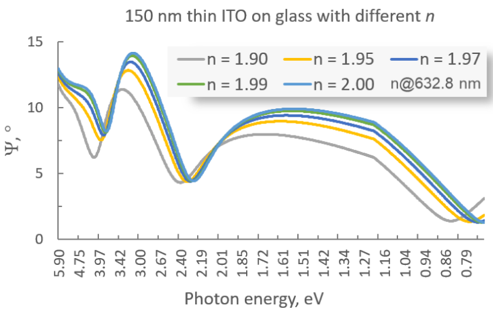
Display applications: measurements of a-Si, poly-Si, microcrystalline-Si, OLED layers, color filters, ITO, MgO, polyimide, and liquid crystals are beneficial during display R&D and production.
PRECISION AND ACCURACY
- Data accuracy: Y = 0.006°, D= 0.015°
- Thickness precision, StdDev down to 0.01 Å
- Optical constant precision, StDev down to 0.0001
MEASUREMENT CAPABILITIES
- SE: Y and D over their full wavelength range
- Generalized SE: complete 2×2 Jones matrix for anisotropic samples
- Mueller Matrix SE: all 16 elements of the 4×4 Mueller matrix
- Depolarization: measure and model the non-ideal nature of your sample
Intensity: both reflectance and transmittance, including anisotropic terms such as like and cross-polarized intensities.
Other Applications
- Transmission measurements
- Thermo-optical investigations
- Se measurements on in vivo tissues
WORKING PRINCIPLE
Spectroscopic ellipsometry (SE) measures changes in the reflectance and phase difference between the parallel (Rp) and perpendicular (Rs) components of a polarized light beam upon direct reflection from a surface of liquid or solid sample.
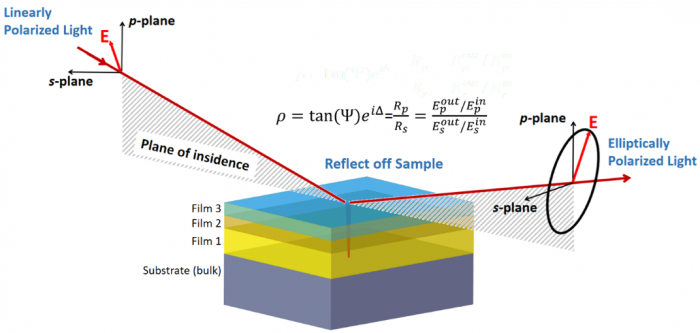
Reflectance (p, s) is described by the main ellipsometric angles Y and D. Because ellipsometry measures the ratio of two values originated by the same signal, the data collected are highly accurate (e.g., can detected thickness down to Å resolution), and reproducible. Most importantly, no reference specimen is necessary; the measurements are independent from the light source intensity and mechanical vibrations.